अवधारणा Music is math. Certain frequencies sound wonderful together (harmony). An octave occurs when the frequency increases by a factor of two.
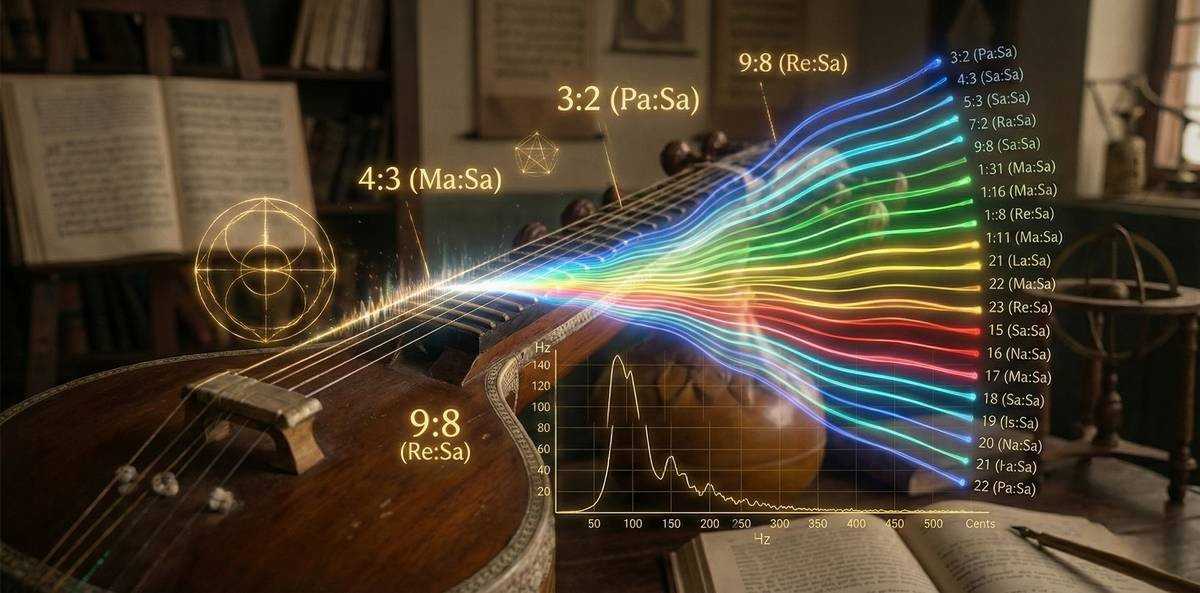
कहानी In India, music was never just an art; it was an exact science of frequency. While the Western world settled on a 12-tone scale, the Natya Shastra divided the octave into 22 microtones called Shrutis. They understood the “harmonic ratio,” knowing that changing the length of a string or the air in a flute changed the pitch mathematically. They even designed instruments like the Sitar with “sympathetic” strings that vibrate on their own, increasing the resonance. This deep understanding of sound physics is the ancestor of the radio waves and Wi-Fi signals that carry our voices across the world today.
समयरेखा
| मील का पत्थर | विवरण |
| पश्चिमी संदर्भ. |
500 BCE (Pythagoras) |
| भारतीय स्रोत |
Prior to 10,000 BCE (Sama Veda) |
| काल अंतराल |
Over 9,000 Years |
मूल पाठ
संस्कृत श्लोक: द्वाविंशतिः श्रुतयः । तत्र स्वराः । तद्यथा षड्जः ऋषभः गान्धारो मध्यमः पञ्चमो धैवतः निषादश्चेति ॥
लिप्यंतरण: Dvāviṃśatiḥ śrutayaḥ | Tatra svarāḥ | Tadyathā ṣaḍjaḥ ṛṣabhaḥ gāndhāro madhyamaḥ pañcamo dhaivataḥ niṣādaśceti || Natya Shastra (Chapter 28) (Discusses the 22 Shrutis and their intervals) .
अर्थ: “There are twenty-two Shrutis. From them come the seven notes: Shadja, Rishabha, Gandhara, Madhyama, Panchama, Dhaivata, and Nishada.”
संबंधित नवाचार The Natya Shastra (about 500 BCE) used an exact 3:2 harmonic ratio to calculate the Samvada (consonance) of notes such as Sa and Pa. Later, luthiers harnessed this science to create the Sitar by adding Tarab (sympathetic) strings that vibrate passively, increasing the instrument’s resonance range.
मजेदार तथ्य The Indian scale Sa-Re-Ga-Ma is thousands of years older than the Western Do-Re-Mi, yet it functions in the same way with major intervals.
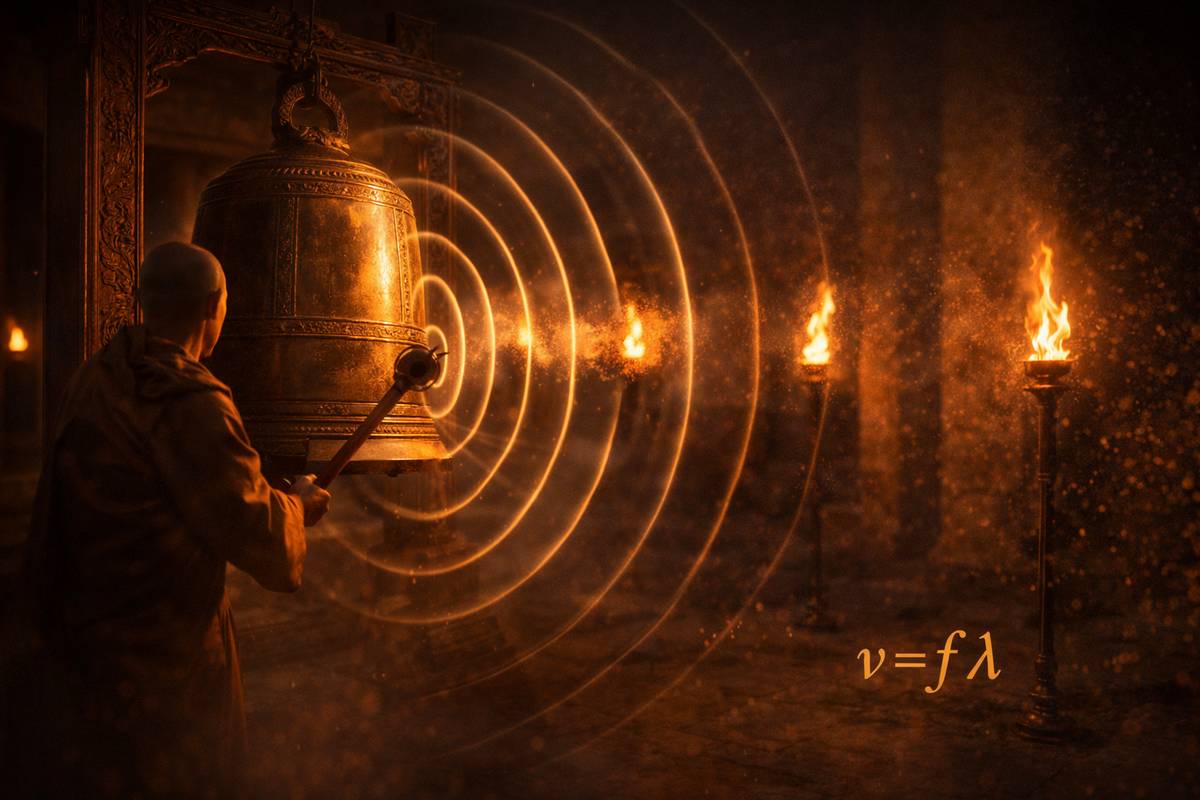
आधुनिक विरासत The science of frequency is what enables radio, Wi-Fi, and audio engineering.