अंक शास्त्र
Not just numbers. A way of recognizing pattern, structure, and order.
अंक शास्त्र
Mathematics in ancient India was not merely a tool for commerce; it was a sacred pursuit. It was the fundamental language used to decode the universe, build flawless architectural structures, and map the staggering depths of cosmic time. Long before the modern era, ancient Indian scholars were treating numbers as a bridge between the physical world and the infinite.
This tradition is unique in its seamless blend of abstract logic and practical application. Mathematicians in ancient Bharat did not just count; they conceptualized Shunya (Zero), formalized the rules of algebra, mapped trigonometric functions to track the stars, and solved infinite series centuries ahead of the West. From the deep antiquity of 10,000 BCE to the brilliant minds of the medieval Kerala School, this is the story of humanity’s greatest numerical leaps.
Explore the key concepts below, organized into thematic sections, providing a structured introduction to the mathematical genius of our ancestors.
The Dawn of Numbers & Arithmetic (Pati-Ganita)
The bedrock of the modern digital world—the decimal place-value system and the concept of Zero—was birthed in ancient India. While other ancient civilizations struggled with cumbersome numeral systems that made complex calculation impossible, Indian mathematicians realized that by giving “nothingness” a mathematical value, they could unlock infinite computational power.
Even in the deepest antiquity of the Vedic age, the Rishis were comfortable with staggering scales of numbers. While the Greeks maxed out their terminology at a myriad (10,000), the Yajur Veda features names for numbers up to a Parardha (one trillion). This section explores the fundamental arithmetic that shaped global trade, science, and technology.
- The Invention of Shunya (Zero): How a philosophical concept of “nothingness” became the most important digit in human history.
- The Decimal Place-Value System: The 1-9 numeral system that the Arabs transmitted to Europe, forever changing global mathematics.
- Ananta (Infinity): The realization in the Isha Upanishad that if you take infinity from infinity, infinity remains.
Sacred Geometry & Architecture (Sulba Sutras)
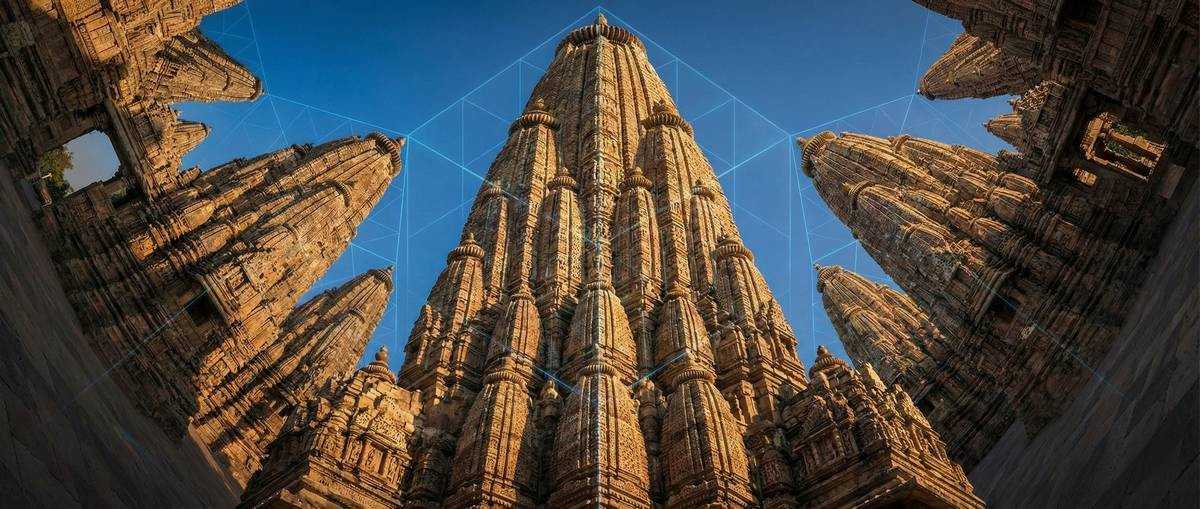
Thousands of years ago, the construction of Vedic fire altars (Yajnas) demanded absolute, flawless precision. To ensure the altars representing the Earth and Heaven were perfectly balanced, the ancient engineers developed sophisticated geometric manuals known as the सुल्बा सूत्र.
Dating back to the earliest echoes of our civilization, these texts prove that ancient Indians were not just guessing; they were applying rigorous structural logic. They contained the earliest known applications of what is now called the Pythagorean theorem, the calculation of the square root of 2, and complex geometric transformations.
- Baudhayana and the “Pythagorean” Theorem: Uncovering the right-angled triangle rules centuries before Pythagoras was born.
- Squaring the Circle: The brilliant, ancient geometric algorithms used to transform circular altars into square ones of the exact same area.
- The Value of Pi : How ancient mathematicians calculated Pi to incredible decimal accuracy to ensure architectural perfection.
Algebra & Equations (Bija-Ganita)
Indian mathematicians recognized early on that arithmetic had its limits, so they developed Bija-Ganita (the “mathematics of seeds” or Algebra). They understood that to solve the mysteries of planetary motion, they needed to calculate unknown variables.
Scholars like Brahmagupta and Bhaskara II were the first to formalize the rules for working with negative numbers (representing debt or opposite directions) and zero. They developed brilliant algorithms to solve complex quadratic and indeterminate equations—methods that European mathematicians wouldn’t rediscover for nearly a thousand years.
- The Rules of Zero and Negative Numbers: Brahmagupta’s groundbreaking text, the Brahmasphutasiddhanta, which finally defined how to add, subtract, multiply, and divide with zero.
- The Chakravala Method: A cyclic algorithm to solve indeterminate quadratic equations that stunned modern mathematicians with its elegance.
- Combinatorics and Binary: Pingala’s Chanda Shastras, which mapped out the binary code and the Fibonacci sequence (known as Maatra Meru) long before computers existed.
Trigonometry & Calculus (The Kerala School)
To track the exact, instantaneous motion of the planets, Indian mathematicians had to invent an entirely new branch of mathematics. Moving beyond static geometry, they developed the concepts of sine (Jya) and cosine (Koti-Jya).
By the 14th century, the brilliant scholars of the Kerala School of Mathematics had conceptualized the infinite series and mathematical limits. They solved the precise mechanics of motion and curves, successfully laying the foundational groundwork for modern Calculus hundreds of years before Isaac Newton or Gottfried Leibniz.
- The Invention of Sine (Jya): How Aryabhata mapped the circle to track the exact positions of the planets.
- Madhava’s Infinite Series: The staggering 14th-century formulas that calculated Pi and trigonometric functions to precise decimal points.
- Instantaneous Velocity (Tatkalika Gati): Bhaskara II’s conceptualization of differential calculus to measure planets in motion.
The Unbroken Thread: A Timeline of Mathematical Giants
The narrative of Indian mathematics is not a fragmented history; it is an unbroken thread of continuous discovery, stretching from the deep Vedic age to the dawn of the modern era.
- The Vedic Era (c. 10,000 BCE onwards): The earliest hymns of the Rig Veda and Yajur Veda demonstrate a profound grasp of massive numbers, fractions, decimal bases, and the conceptualization of deep time (Yugas).
- Baudhayana: Author of the earliest known सुल्बा सूत्र, formalizing the geometry of right angles and calculating the square root of 2.
- Pingala: Wrote the Chanda Shastras, introducing the first known description of a binary numeral system and the “Fibonacci” numbers.
- Aryabhata: Wrote the Aryabhatiya at age 23, introducing trigonometric sines, the value of Pi (3.1416), and the mathematical proof that the Earth rotates on its axis.
- Brahmagupta: The father of modern arithmetic. First to formulate the strict mathematical rules of zero and negative numbers.
- Bhaskara II: Authored the Lilavati and Bijaganita, conquering complex algebra and laying the conceptual seeds of differential calculus.
- Madhava of Sangamagrama: The founder of the Kerala School. He discovered the infinite series for sine, cosine, and arctangent, pushing humanity over the threshold into modern calculus.
Understanding Reality Through Numbers
When you look at this timeline, a powerful realization sets in. Ancient Indian mathematics represents a staggering intellectual leap—from the philosophical realization of infinity (Ananta) to the rigorous, practical calculation of planetary orbits.
Our ancestors did not wait for any Scientific Revolution to understand the universe. They built it. The algorithms running on your smartphone, the binary code of the internet, the calculus used to launch satellites, and the very numbers you type every day all carry the DNA of ancient Bharat. This is not just history; it is a profound inheritance.