अवधारणा
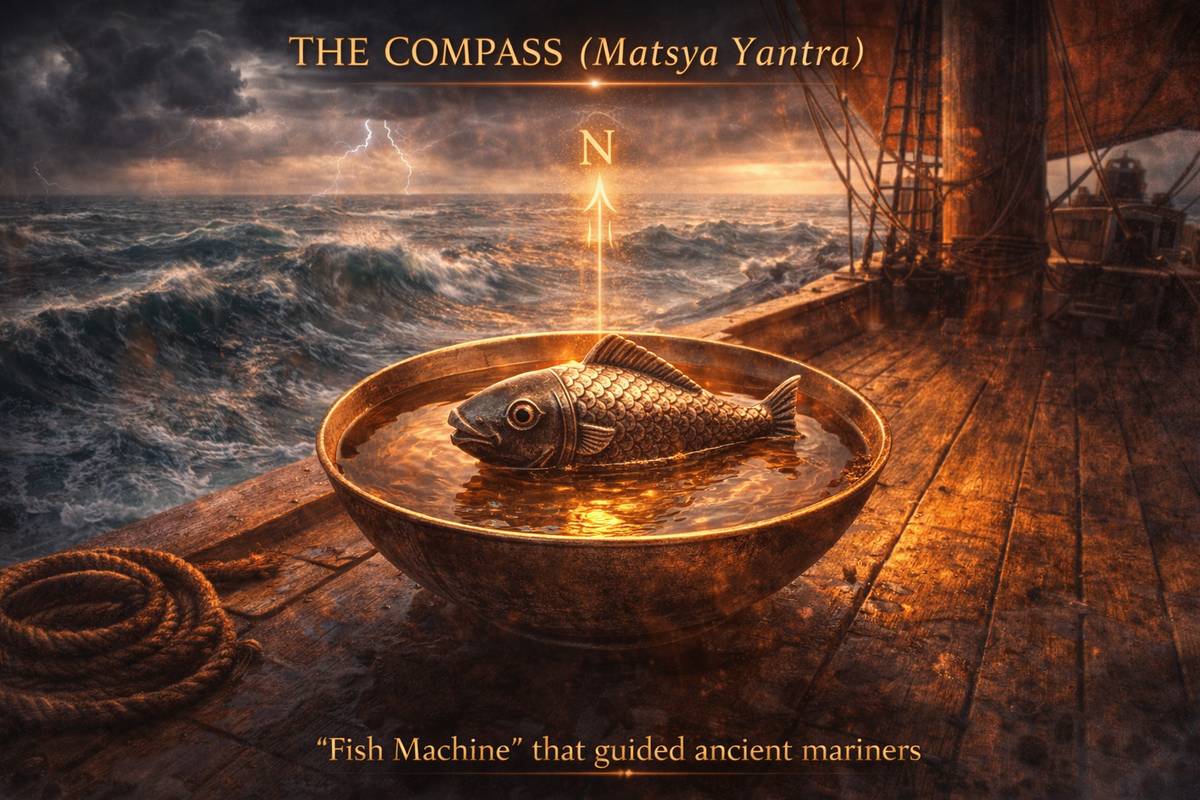
To navigate the high seas, you must first know where North is. A magnetised needle floating in oil will always point north.
कहानी
To rule the Indian Ocean, the great Chola navy needed more than just brave sailors; they needed a way to find North in the middle of a featureless sea . Long before the European Age of Discovery, Indian maritime texts described the Matsya Yantra—a magnetized “iron fish” floating in a vessel of oil. Because the iron was naturally attracted to the North Pole, it served as a permanent guide. While others relied on “shore-sighting birds” or the stars, Indian navigators were using the Earth’s own magnetic field to reach as far as Africa and Indonesia, turning the ocean into a mapped highway.
समयरेखा
| मील का पत्थर | विवरण |
| पश्चिमी संदर्भ. |
1190 CE (First European mention) |
| भारतीय स्रोत |
Prior to 400 CE (Tamil Maritime History); 500 CE (Varahamihira) |
| काल अंतराल |
Over 700 Years |
मूल पाठ
संस्कृत श्लोक: न योजयेद् अत्र लोहं बन्धने न कदाचन । लोहकान्तपाषाणाः महान्धौ सन्ति वारिधौ ॥
लिप्यंतरण: Na yojayed atra lohaṃ bandhane na kadācana | Lohakāntapāṣāṇāḥ mahāndhau santi vāridhau || Yuktikalpataru (Bhoja) (Describes magnets used in navigation) .
अर्थ: “Do not use iron in the joints/binding (of the ship) at all. For there are magnetic loadstones (Lohakanta) in the great ocean (which could drag the ship to ruin).”
संबंधित नवाचार
Star Navigation: Using the height of the Pole Star (Dhruva) to find latitude at sea (Lagadha’s Vedanga Jyotisha, c. 1400 BCE). Shore-Sighting Birds: Carrying birds (Disha-Kaka) on ships and flying them towards the nearest land (Rig Veda, Digha Nikaya).
मजेदार तथ्य
The Sanskrit word for ‘guidance’ is ‘Marga-Darshana,’ but distinct words were used for the compass, which means ‘a machine that finds the direction’.
आधुनिक विरासत
The magnetic compass (and now the digital compass on your phone) is the foundation of contemporary science; without it, worldwide trade and travel are impossible .