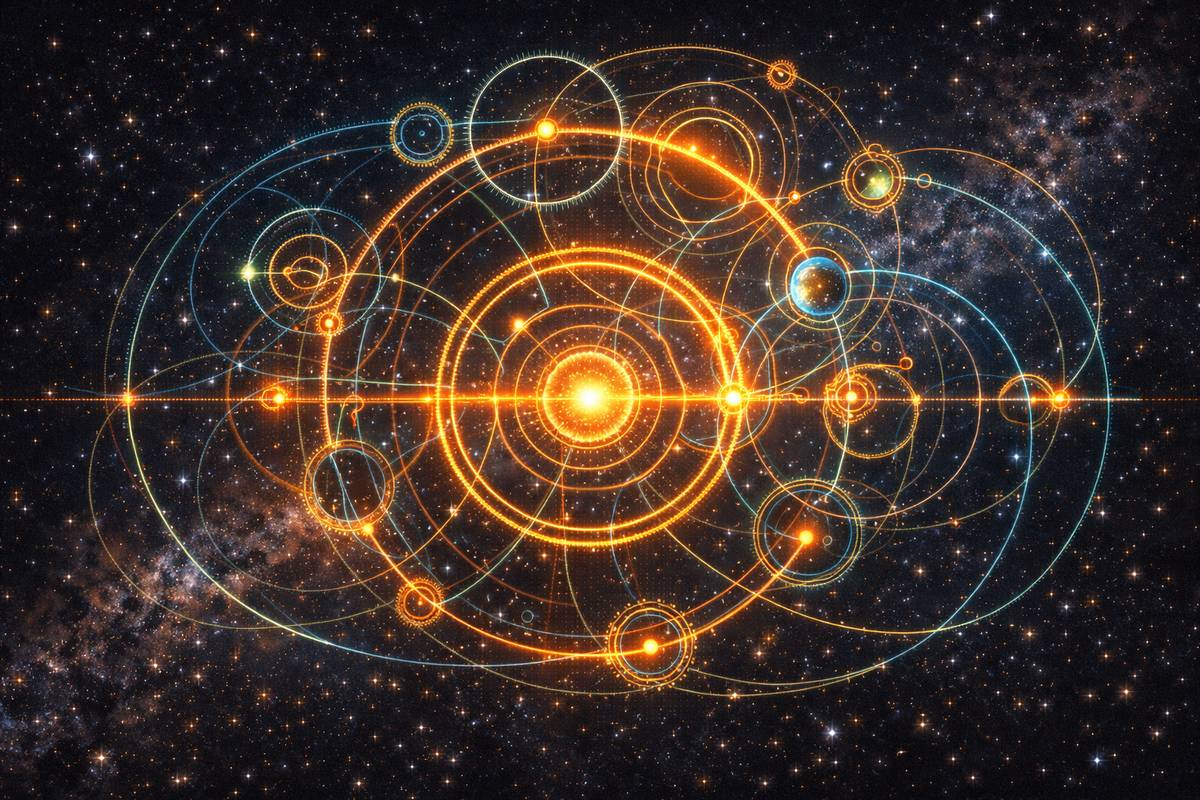
अवधारणा The Surya Siddhanta uses epicycles (circles that travel on circles) instead of ellipses to explain why planets accelerate and slow down. It makes two changes: Manda (the distance from the orbit) and Shighra (the speed relative to Earth). The text is remarkable in that it employs changing epicycles, which means that the size of the circle varies depending on where the planet is. This flexible algebra is significantly more effective at recreating elliptical orbits than rigid Greek circles.
कहानी Planets don’t move in perfect circles; they speed up and slow down, creating a headache for ancient astronomers. While the West followed Ptolemy’s rigid, fixed circles, the Surya Siddhanta introduced a more fluid logic: the variable epicycle. They used Manda (distance correction) and Shighra (relative speed) to create “flex-circles” that changed size depending on the planet’s position. This sophisticated algebra allowed them to recreate elliptical orbits with such precision that their models can still predict Mars’ location today with an accuracy that rivals modern instruments.
समयरेखा
| मील का पत्थर | विवरण |
| पश्चिमी संदर्भ. |
c. 150 CE (Ptolemy) |
| भारतीय स्रोत |
Surya Siddhanta (10,000 BCE) |
| काल अंतराल |
10,000 वर्षों से भी अधिक |
मूल पाठ
The Surya Siddhanta (2.12) describes this method with the phrase ‘Mandocchat karnavat.’.
संबंधित नवाचार The Hypotenuse (Karna) – Using the epicyclic triangle to calculate the precise distance to a planet. Source: Surya Siddhanta.
मजेदार तथ्य Did you know that the Surya Siddhanta model is so strong that it can still predict Mars’ current location with an inaccuracy visible only to instruments?.
आधुनिक विरासत This is the forerunner of Fourier analysis, which combines simple circular motions to create complex curves.