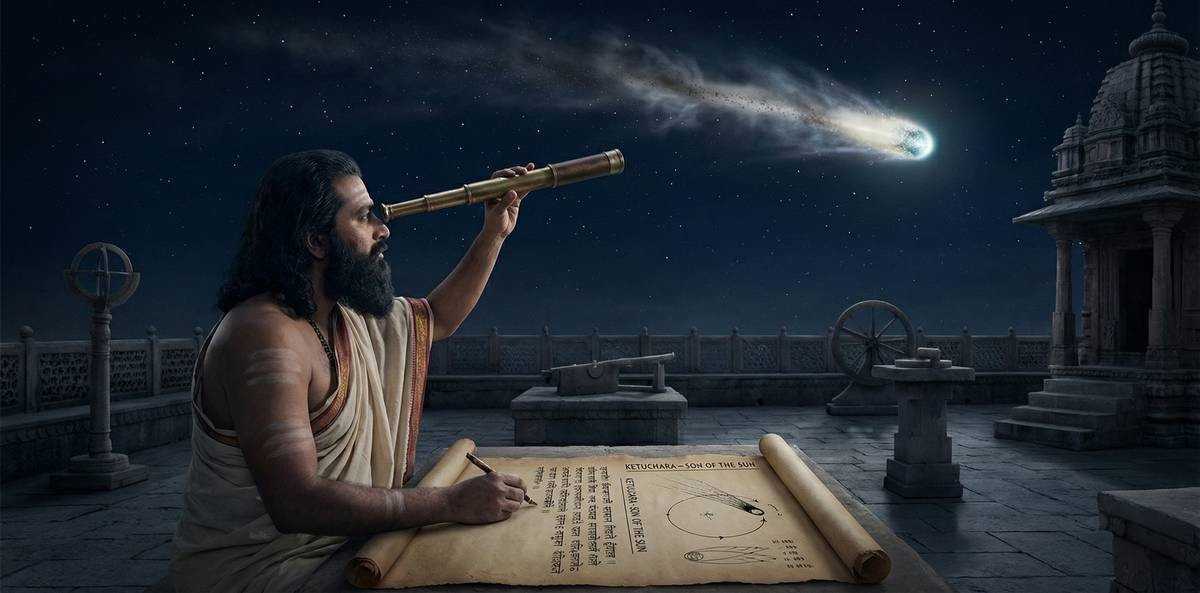
अवधारणा People used to believe that comets were unpredictable foreshadowings of dreadful things to come. They are icy creatures that emit gas or dust, hence their nickname ‘dirty snowballs’.
कहानी For much of history, comets were viewed as unpredictable omens of doom, but the Indian polymath Varahamihira treated them like a laboratory subject. In his 6th-century masterpiece, the बृहत् संहिता, he documented over 1,000 different types of comets, classifying them by their tails, shapes, and the specific regions of the sky they emerged from. He even described their tails as “smoke” (Dhumaketu), predating the modern understanding of comets as “dirty snowballs” that outgas as they approach the Sun. While Europe waited until 1705 for Halley to predict a comet’s return, India had been cataloguing these cosmic visitors for millennia.
समयरेखा
| मील का पत्थर | विवरण |
| पश्चिमी संदर्भ. |
1705 CE (Halley’s prediction) |
| भारतीय स्रोत |
500 ईस्वी (वराहमिहिर); Prior to 10,000 BCE (Atharva Veda) |
| काल अंतराल |
11,000 वर्षों से भी अधिक |
मूल पाठ
The बृहत् संहिता (Chapter 11) provides a detailed classification of comets under the heading ‘Ketur…’.
संबंधित नवाचार The बृहत् संहिता (c. 550 CE) classified comets (Dhumaketu) by describing their tails as ‘smoke’ and recognised the periodicity of distinct celestial bodies, indicating their recurrence after predetermined intervals.
मजेदार तथ्य Varahamihira was the first person in the ancient world to compile a list of over 1,000 different types of comets.
आधुनिक विरासत The study of comets forms the foundation of modern science. It helps us understand the early formation of the solar system and the origin of water on Earth.