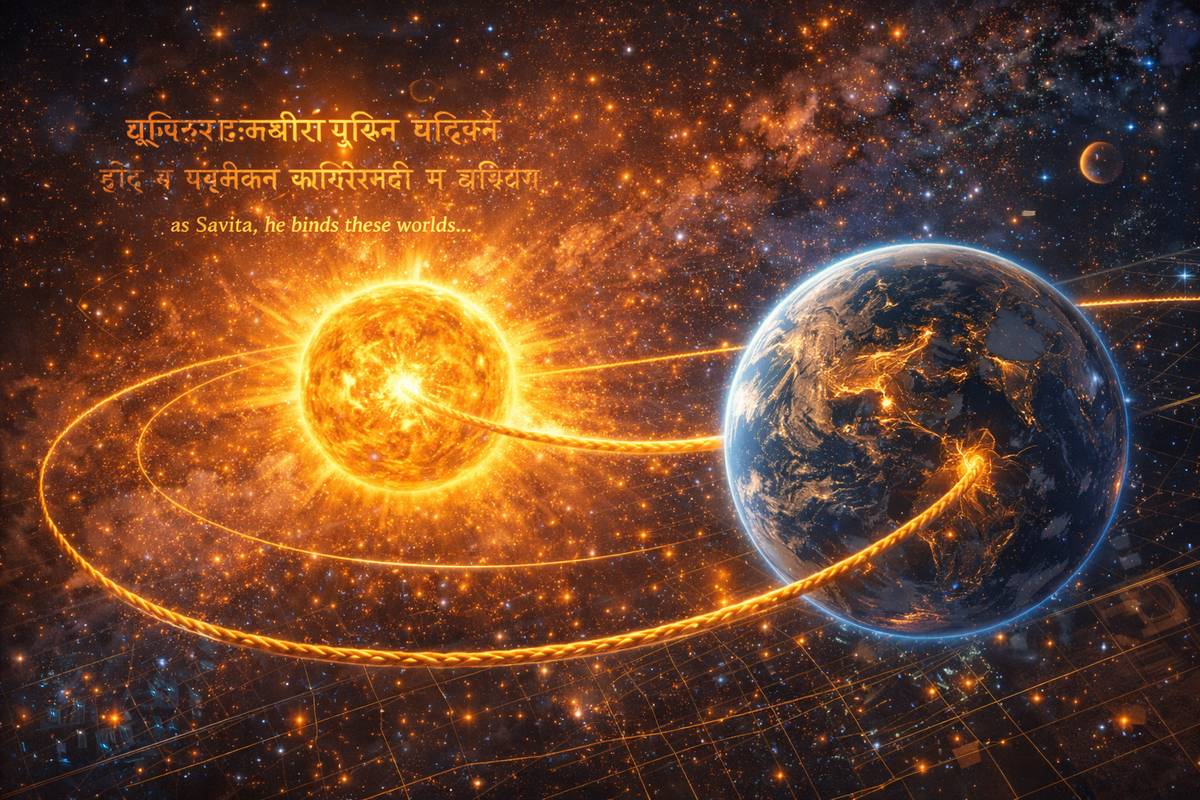
Archaeo-Astronomy
Where history meets the sky.
Not all ancient texts speak in stories. Some speak in stars.
When we read ancient texts, it is easy to assume that we are dealing with mythology—symbolic narratives shaped over time. But every now and then, something unusual appears.
A reference to a star.
A specific planetary alignment.
A description of an equinox occurring in a particular Nakshatra.
At first glance, these may seem poetic. But look a little closer, and a different possibility emerges. What if these are not just descriptions—but observations? And if they are observations, then a more interesting question follows. Can we test them?
From Narrative to Measurable Data
One of the most powerful aspects of astronomy is its precision. Unlike written records, the sky does not change its past. The positions of stars and planets can be calculated backward with remarkable accuracy. This is where archaeo-astronomy comes in. It is the study of how ancient cultures observed the sky—and how those observations can be used to understand historical timelines. Instead of relying only on textual interpretation, it introduces a measurable dimension. In simple terms, if a text describes a specific celestial event, we can ask: when did that event actually occur?
Astronomy Hidden in Plain Sight
Ancient Indian texts are rich with astronomical references.
These include:
– Positions of Nakshatras (lunar constellations)
– Planetary conjunctions
– Solar and lunar eclipses
– Seasonal markers like solstices and equinoxes
What makes these references particularly valuable is their specificity. They are not vague descriptions of the sky—they often point to precise configurations. You might notice something here. These are not the kinds of details one invents casually. They suggest observation, recording, and transmission. And that opens the door to analysis.
The key idea is simple: the sky is a record that cannot be altered. If the description is precise, the date can be tested.
Modern Researchers and Ongoing Work
In recent years, several researchers have applied archaeo-astronomical methods to ancient Indian texts. Among them, figures like Nilesh Oak and Rupa Bhaty have attempted to analyze large numbers of astronomical references—particularly from texts like the Mahabharata and Ramayana. Their work involves extracting hundreds of celestial observations and testing them against astronomical simulations. Some of their proposed timelines extend much further back than conventional historical models suggest.
Now, it is important to be clear. These findings are part of an ongoing discussion. They are not universally accepted. But they do demonstrate something significant—that ancient texts can be studied using scientific tools, not just interpreted through tradition or translation.
What This Method Can—and Cannot Do
Like any scientific approach, archaeo-astronomy has both strengths and limitations. On one hand, it provides a way to test historical claims using objective data. It introduces precision into a field that often relies on interpretation. On the other hand, it depends on how accurately ancient descriptions are understood. Translating poetic language into exact astronomical parameters is not always straightforward. There is also the question of transmission. Texts may have been edited, expanded, or recompiled over time. So while the method is powerful, it must be applied carefully. And perhaps that is the right approach—to use it not as a final answer, but as a tool for deeper inquiry.
What This Reveals About Ancient India
If even a portion of these astronomical references are based on observation, it suggests something important. It means that ancient Indian scholars were not just storytellers—they were observers of the natural world. They were tracking cycles, noting patterns, and preserving data across generations. This aligns with what we see across other domains—mathematics, medicine, and linguistics—where structured thinking and systematic knowledge appear repeatedly. Archaeo-astronomy does not stand alone. It fits into a broader pattern of inquiry.
Why This Matters Today
At first glance, this might seem like a discussion about the past. But it has implications for the present. The way a civilization understands its history shapes how it sees itself. If that history is seen as recent and fragmented, it limits perspective. If it is seen as deep and continuous, it expands it. This is not about claiming superiority. It is about recognizing contribution. Modern science is a global achievement. But like any structure, it rests on many foundations. Ancient India is one of them.
There is something quietly powerful about the idea that the sky can act as a historical record. Long after monuments erode and manuscripts fade, the stars remain. And in their movement, they carry a memory—not in words, but in patterns. Maybe that is what makes archaeo-astronomy so compelling. It does not ask us to believe. It asks us to look up—and verify.