Ancient History of Hindu Civilization
Not all history is written in books.
Some of it is written in the sky, waiting to be read again.
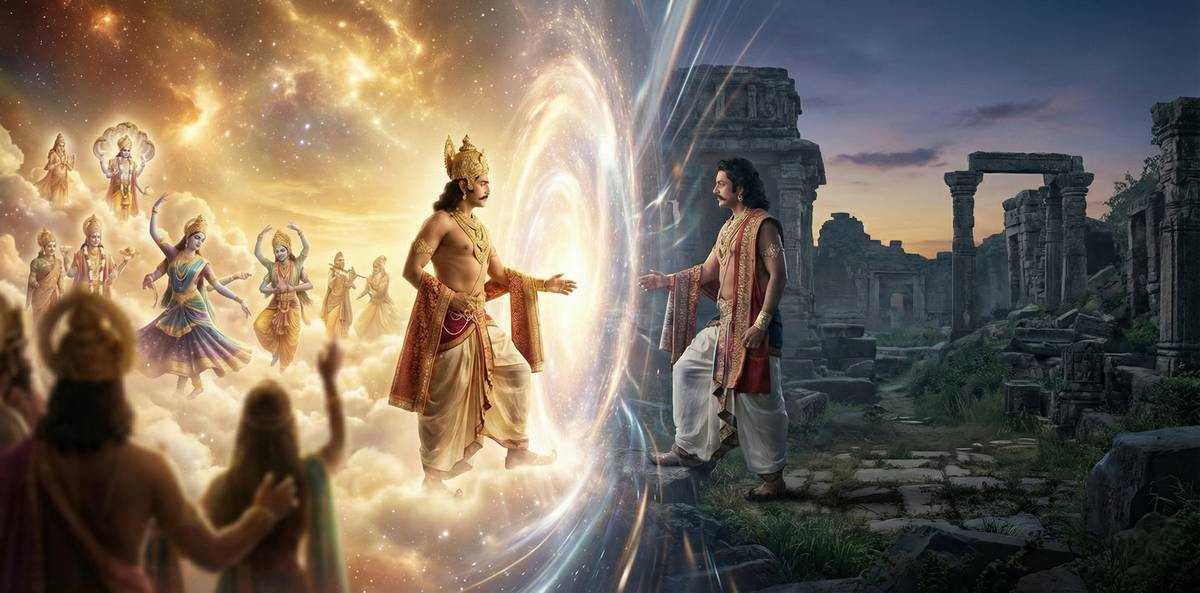
History, we often assume, is a fixed record—dates, events, and timelines arranged neatly in sequence. But the moment we begin to explore ancient India, that neatness starts to dissolve. In my experience, there is something unusual about how Indian civilization is presented. It feels compressed. As if a vast and continuous story has been reduced into a narrow window of a few thousand years. And naturally, a question begins to form. Is it possible that what we call “ancient history” is only a fragment of a much deeper continuity?
The Limits of Conventional Timelines
For a long time, the dominant historical model placed the origins of Vedic civilization around 1500 BCE. This framework, largely shaped during colonial scholarship, attempted to fit India into a linear global narrative. But this model comes with limitations. It assumes that civilizations develop in a straight line—from primitive to advanced. And it often relies on textual interpretation while overlooking internal scientific markers embedded within those texts. You might notice something interesting here. Many ancient Indian texts do not present themselves as new compositions. They speak as part of an already existing tradition. That alone suggests depth—perhaps far beyond what standard timelines allow.
INDIC TIME FRAMEWORK
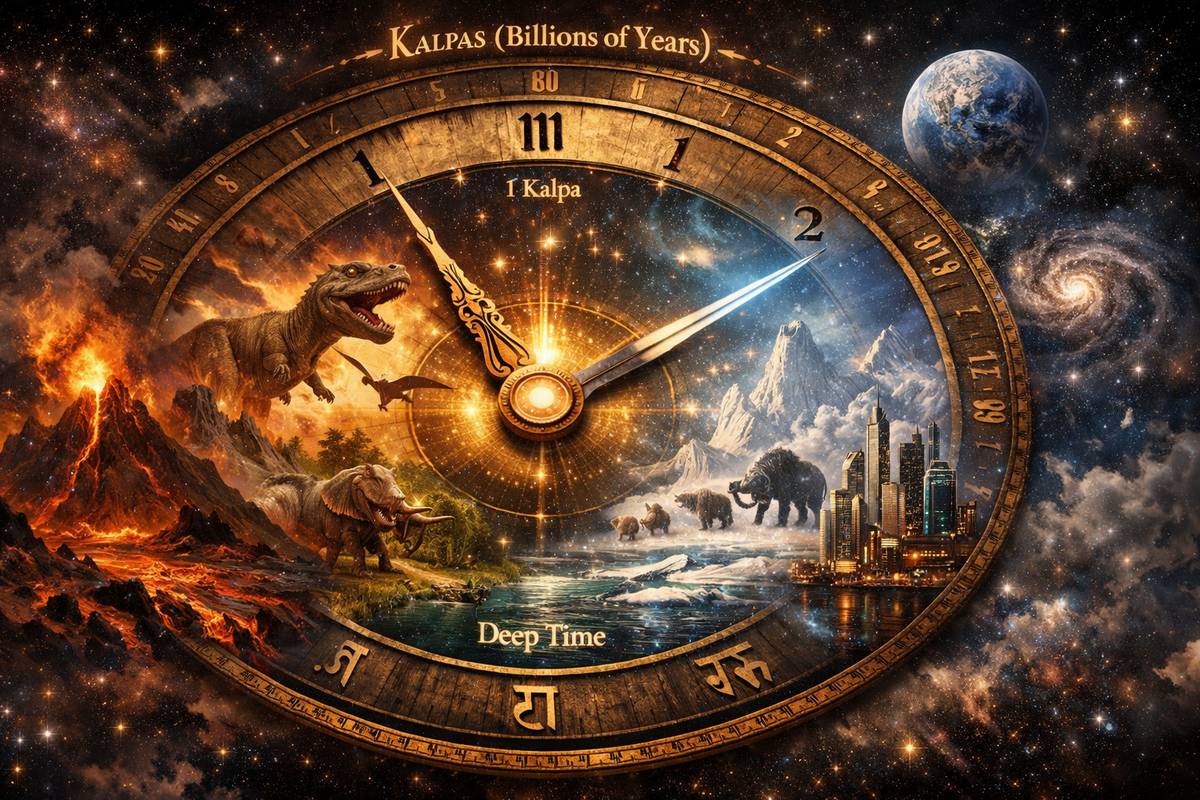
One of the most distinctive aspects of the Indian tradition is its approach to time. Instead of a short, linear progression, we encounter concepts like Yugas and Kalpas—cycles that span vast durations. Whether interpreted symbolically or cosmologically, they reflect a mindset that is comfortable with deep time. And that matters. Because a civilization that thinks in cycles does not feel the need to compress its past. It naturally accommodates continuity, recurrence, and long-term evolution. In many ways, this perspective aligns more closely with modern scientific understanding than earlier historical models that confined the world to a few thousand years.
When the Sky Becomes a Historical Record
What makes ancient Indian texts particularly unique is that they do not rely only on narrative. Many of them contain precise astronomical references—positions of stars, planetary alignments, and seasonal markers. Unlike stories, these can be tested. This has given rise to the field of archaeo-astronomy, where modern tools are used to reconstruct the night sky of the past. Researchers like Nilesh Oak and Rupa Bhaty have applied this method to ancient epics, attempting to derive timelines based on verifiable celestial data. These findings are still debated, and rightly so. But the method itself changes the nature of the discussion. It moves history from interpretation toward measurable analysis. And that is a significant shift.
If a text describes a specific planetary alignment, that alignment can be calculated. The sky, unlike written history, does not change.
A Civilization of Continuity, Not Fragmentation
Perhaps the most striking feature of Hindu civilization is continuity. Rather than appearing in isolated phases, knowledge seems to evolve across generations:
Vedas → Upanishads → Sutras → Classical Sciences
Each stage does not replace the previous one—it builds upon it. This is not a fragmented history. It is a flowing one. And once you begin to see it that way, the entire structure of Indian civilization starts to look different. Not as disconnected periods, but as a continuous intellectual tradition.
The Knowledge Backbone of Civilization
The Philosophy Behind the Knowledge
One of the most subtle aspects of ancient Indian civilization is that science and philosophy were never separate. Concepts like Rta (cosmic order), Karma (causality), and Ananta (infinity) were not abstract ideas. They shaped how reality was observed. If the universe follows an order, it can be studied. If actions have consequences, causality becomes meaningful. So what we see here is not just knowledge—but a framework that makes knowledge possible.
And I think that distinction is easy to miss, but deeply important.
Why This Perspective Matters Today
At first glance, this might seem like a discussion about the past. But it has implications for the present. The way a civilization understands its history shapes how it sees itself. If that history is seen as recent and fragmented, it limits perspective. If it is seen as deep and continuous, it expands it. This is not about claiming superiority. It is about recognizing contribution.
Modern science is a global achievement. But like any structure, it rests on many foundations. Ancient India is one of them.
Perhaps the most interesting thing about ancient history is not what we know, but how much remains open to exploration.
The texts are still there.
The sky is still there.
And the questions are still alive.
Maybe that is how this subject is meant to be approached—not with final answers, but with a sense of inquiry. Because history, like the universe itself, may be far deeper than it first appears.